
What Is A Cubicle: Definition, Types, and Benefits In 2026
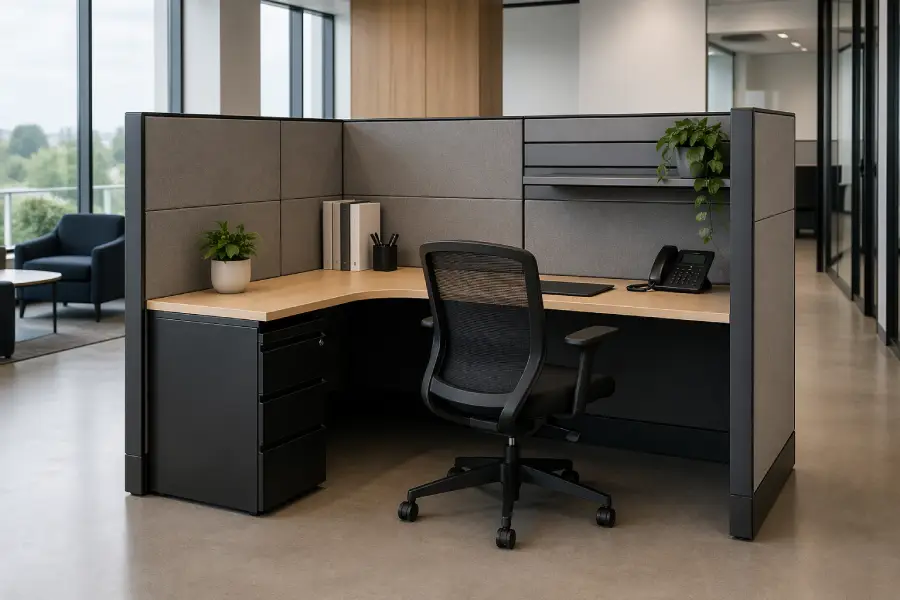
To answer directly: what is a cubicle?
An office cubicle is a semi-enclosed workspace in an office, created with partition panels to provide privacy, organization, and individual work areas within an open layout.
In fact, the cubicle’s meaning in office design refers to a practical solution for balancing privacy and teamwork, without the need for completely enclosed rooms.
With the shift in work styles and the rise of hybrid work, the cubicle definition remains relevant in 2026, as it helps organizations provide flexible, cost-effective, and focused workspaces for employees while still maintaining workplace interactions.
What Is a Cubicle?
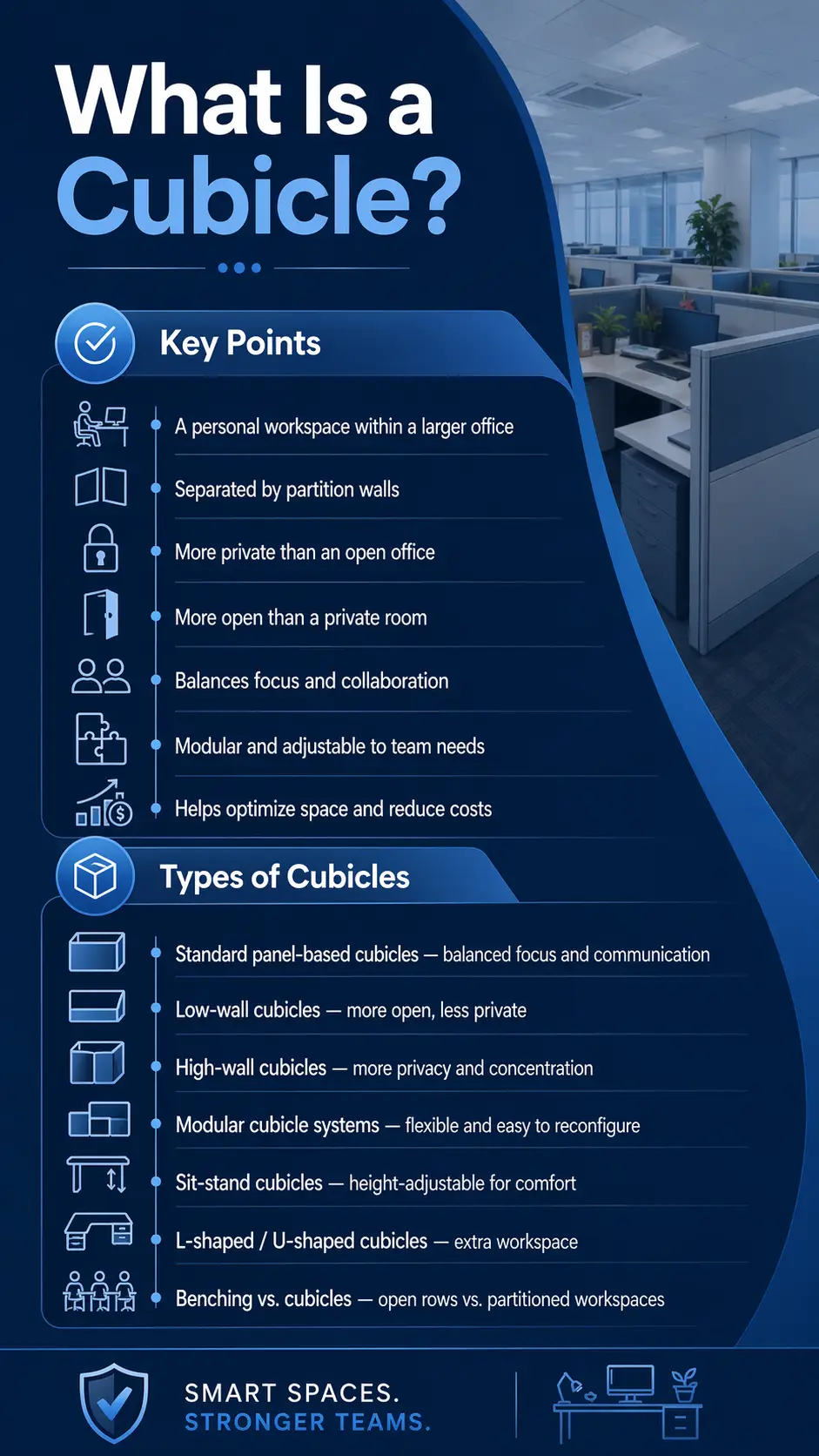
For a typical user, a cubicle is a personal space within a large office.
Your office desk is located and is separated from others by short walls.
This space is neither completely closed like a room nor completely open like an open office.
The result of this design is a balance between focus and easy access to colleagues.
From a more specialized perspective in office planning, a cubicle is a modular unit of workspace that is constructed with adjustable partitions.
Its goal is to optimize space utilization, reduce costs, and strike a balance between privacy and collaboration.
The size, height of the partition, and how it is arranged can be changed based on the team’s needs and the type of work.
You Might Also Enjoy: How AI is Influencing Furniture Design in 2026
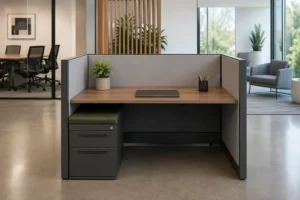 Cubicle Meaning in Office Design
The difference between a cubicle and a partition:
A partition is just a physical separator, like a wall or screen.
But a cubicle is a complete workspace that includes a desk and a designated area for one person.
The difference between a cubicle and an enclosed office:
An enclosed office is a complete room with walls and doors, and offers greater privacy.
But a cubicle does not have a full wall and usually has short partitions, so communication with the surroundings is maintained.
Why is a cubicle a semi-private workspace?
It provides a level of privacy, but does not separate the user from the team environment.
This design allows for individual focus to be maintained while also allowing for interaction and collaboration.
What Are the Main Parts of a Cubicle?
A cubicle is not just a simple desk.
In fact, it is a complete workspace that consists of several main sections to be both functional and increase user comfort.
- Panels/walls: This section is the walls surrounding the cubicle, which are usually short and modular.
Their function is to create a relative sense of privacy and reduce distractions in busy office environments.
- Desk or work surface: The desk or work surface is the central part of a cubicle, where computers, documents, and daily work tools are placed.
- Its design should provide enough space for daily work.
- Storage: Includes drawers, files, or small cabinets.
This section helps keep work items organized and makes the desk space more private.
- Cable & power management: It is a cable and socket management system.
This section is used to prevent clutter from wires and increase safety and order in the workspace.
- Ergonomic accessories: They include equipment such as a monitor arm, ergonomic office chair, or laptop stand.
Its goal is to reduce fatigue and increase comfort during long working hours.
Why Do Companies Still Use Cubicles in 2026?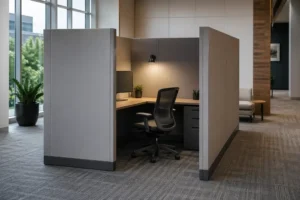
Are cubicles outdated in 2026?
Even with open offices and the rise of remote work, cubicles as commercial office furniture are still used in many companies.
The reason is that this model strikes a real balance between focus, cost, and collaboration.
Privacy
The cubicle creates a clear boundary for each employee.
This boundary is not perfect, but it is enough for the person to feel ownership of their space.
This has an impact on reducing stress and increasing psychological comfort in the workplace.
Focus
In today’s tasks that require high accuracy, focus is important.
Cubicle partitions help the mind become less distracted by the surrounding environment, resulting in improved work quality and fewer errors.
Less Distraction
In open-plan offices, there is a lot of movement, conversation, and noise.
Cubicles partially filter out these distracting inputs.
This is especially important for analytical work or long periods of focused work.
Acoustic Control
Although the cubicle is not completely soundproof, it does reduce noise to some extent.
This slight reduction makes calls, online meetings, and focused work easier.
Flexibility
One of the important advantages of a cubicle is that it does not have a fixed structure.
Companies can move it, increase or decrease its number, or change the layout.
This feature is very useful for teams that are growing rapidly.
Lower Cost Than Private Offices
Building separate rooms is expensive and takes up more space.
The cubicle solves this problem.
At a lower cost, it is possible to create a standard space for a larger number of employees, without compromising the quality of the work environment.
You Might Also Enjoy: How to Disassemble Office Cubicles in 30 Minutes?
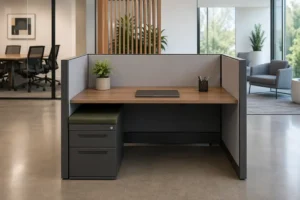 Pros and Cons of Cubicles
Cubicles are still used in many offices because they have both advantages and limitations.
Understanding both parts helps us better decide whether this model is suitable for a work environment.
Benefits:
- Focus: A cubicle reduces distractions by separating each person’s space.
This is very important for detailed and long-term work.
- Personal space: Each employee has a defined scope.
This sense of ownership creates greater comfort and reduces stress in the workplace.
- Organization: Having a dedicated desk and space helps keep work materials more organized. This order also has a positive impact on productivity.
- Scalability: Companies can easily increase or decrease the number of cubicles.
This feature is very useful for growing teams.
- Reconfiguration: Cubicles are usually modular.
Meaning they can be moved or redesigned without a lot of construction cost.
Drawbacks:
- Can feel closed-in: If the design is not appropriate, the user may feel constrained or cramped, especially in small or poorly lit spaces.
- Less spontaneous collaboration: Although partitions are short, they still slightly limit quick and natural communication between people.
- Poor design can feel outdated: If cubicles are not designed to be up-to-date, the office environment can look outdated and boring.
This also affects employee motivation.
Types of Cubicles
Cubicles are not a single fixed model.
There are different types depending on the type of work, the level of concentration required, and the office design.
1. Standard panel-based cubicles
This model is the most common type.
It uses medium-height partitions, giving each employee a defined workspace.
It is suitable for everyday office work and provides a good balance between focus and communication.
2. Low-wall cubicles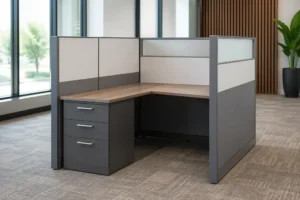
In this model, the walls are shorter.
The space feels more open, and communication between employees is easier.
But the level of privacy and noise reduction is lower.
3. High-wall / more private cubicles
This type has taller walls.
Provides greater focus and privacy.
Suitable for tasks that require silence and high accuracy.
4. Modular cubicle systems
These systems are portable and changeable.
Companies can change the layout quickly.
It’s a good option for growing teams or dynamic offices.
5. Sit-stand cubicles
This model is designed with height-adjustable desks.
The user can switch between sitting and standing.
Its goal is to improve health and reduce fatigue.
6. L-shaped / U-shaped cubicles
This design provides the user with more workspace.
Suitable for people who work with multiple devices or monitors at the same time.
7. Benching vs cubicle systems
In an office benching, desks are arranged in rows without full partitions.
The space is more open, but there is less personal privacy.
In contrast, a cubicle system is separated by partitions and provides greater focus.
You Might Also Enjoy: How to Assemble Office Cubicles in 30 Minutes?
Who Should Choose Cubicles?
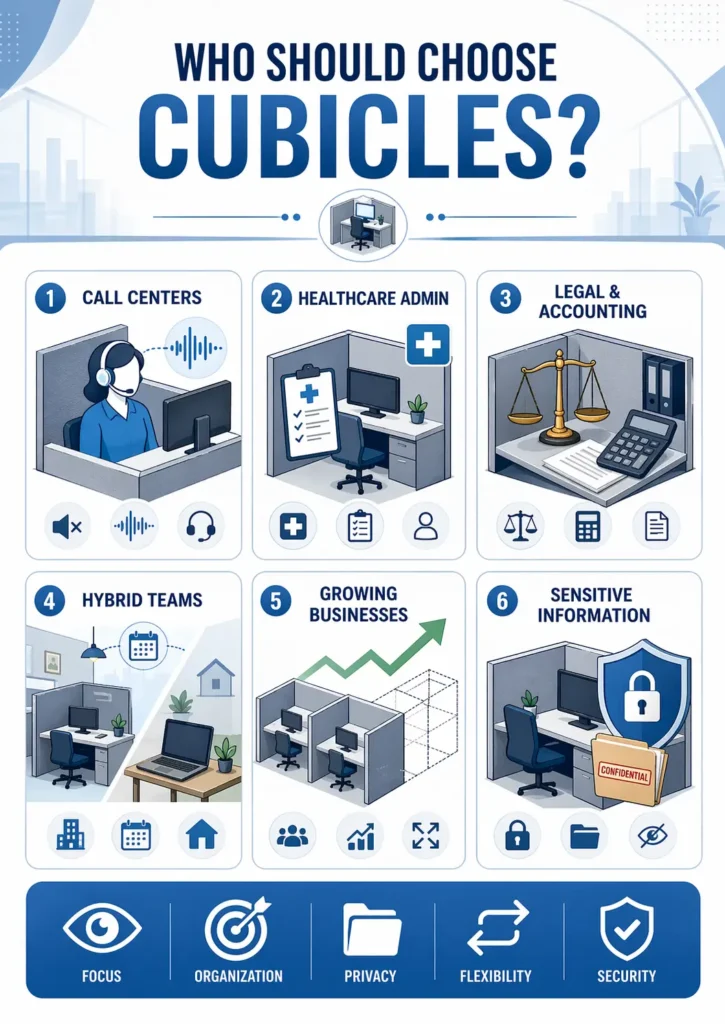
Cubicles aren’t necessary for every company, but for some workplaces, they really are the right choice.
Especially when focus, order, and information privacy are important.
- Call centers: The volume of calls is high in these environments.
Cubicles help each employee have a specific space and reduce noise and distractions.
- Healthcare admin: Administrative work in hospitals or clinics requires accuracy and confidentiality.
Cubicles help maintain focus and improve organization when processing information.
- Legal / accounting offices: In law and accounting offices, sensitive information abounds.
A cubicle provides a suitable level of privacy and helps focus on documents.
- Hybrid teams: In hybrid teams, people spend part of their time in the office.
The cubicle provides a defined, consistent space for their physical presence.
- Growing businesses: Fast-growing companies need flexible space.
Cubicles are easy to add or move and keep pace with team growth.
- Companies handling sensitive information: In organizations that work with confidential data, cubicles help restrict visual and audio access and better maintain information security.
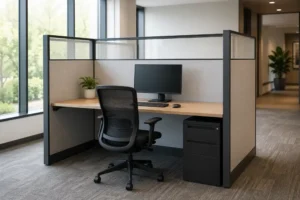 Typical Cubicle Sizes and Layout Planning Tips
Proper cubicle design is not just about choosing a model.
Its size and layout have a direct impact on comfort, focus, and productivity.
Common Dimensions
Cubicles are usually between 1.5 and 3 meters wide.
Their depth is about 1.5 to 2 meters.
This size should provide enough space for a table, chairs, and easy user movement, without making the space too crowded.
Aisle/Circulation Space
There should be a walkway between the rows of cubicles.
This distance is usually about 90 to 120 centimeters.
If it is less, it becomes difficult to move, and if it is more, space is wasted.
Low-Wall vs High-Wall Selection
Low-wall is suitable for more communication and open space, but has less privacy.
High walls create more focus and privacy, but make the space appear more closed.
Its choice depends on the type of work.
Layout for Team Growth
Design must be forward-looking.
Cubicles should be arranged to allow easy expansion or relocation of sections.
Modular design is very important here.
How to Maximize Usable Square Footage
The right layout can increase office capacity without increasing the area.
Using standard cubicles, eliminating wasted spaces, and designing shorter pathways help maximize the use of every square meter.
You Might Also Enjoy: Where to Donate Office Equipment in The USA: Top 10 Options
How to Choose the Right Cubicle for Your Office?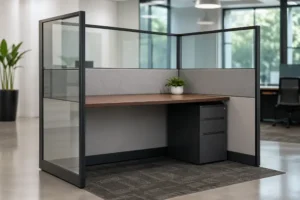
Cubicle choice has a direct impact on employee productivity, comfort, and even satisfaction.
To make the right choice, you need to consider a few key factors.
- Team size: The larger the team, the greater the need for a more flexible layout.
Cubicles should be easy to add or move so they can adapt to the growth of the team.
- Workflow: If tasks are individual and focused, closed cubicles are better.
If there is a lot of collaboration, a more open design would be a better choice.
- Privacy needs: Some professions, such as finance or law, require more privacy.
In this case, cubicles with taller walls are more suitable.
- Acoustics: In crowded environments, noise reduction is important.
Choosing the right partition can reduce environmental noise and increase concentration.
- Budget: Cubicles come in different price ranges.
Simpler designs cost less, while more advanced models offer more features.
- New vs used: New models are durable and have an updated design.
Used models reduce the cost, but may be more limited in appearance or quality.
- Power/data needs: If employees require multiple computer systems or specialized equipment, access to electrical outlets and networking should be considered in the cubicle design.
- Ergonomics: A comfortable chair, the right desk height, and enough space to move around are important.
Ergonomic design reduces fatigue and increases productivity.
Conclusion
To put it simply, a cubicle is a semi-private workspace in an office that falls between an open space and a completely enclosed room.
Its main goal is to create a balance between individual focus and team communication.
A cubicle is suitable for people who need high focus, order, and a dedicated space for daily work.
Conversely, if your main priority is free interaction, instant collaboration, and team creativity, open offices or fully open layouts may be a better option.
Ultimately, the right choice depends on the type of work and your team’s work style.
If you’re still unsure, carefully considering your workspace needs can help you make the best decision for your office design.

John Ofield is the owner of Collaborative Office Interiors. Houston’s trusted source for modern and commercial office furniture, office cubicles, demountable walls, office desks and tables, and complete workspace solutions. With more than 40 years of experience, he combines deep product knowledge with hands-on space-planning expertise to create ergonomic, productivity-focused work environments for businesses across Southeast Texas.