
What Are the Top Materials for Computer Tables and Office Desks?
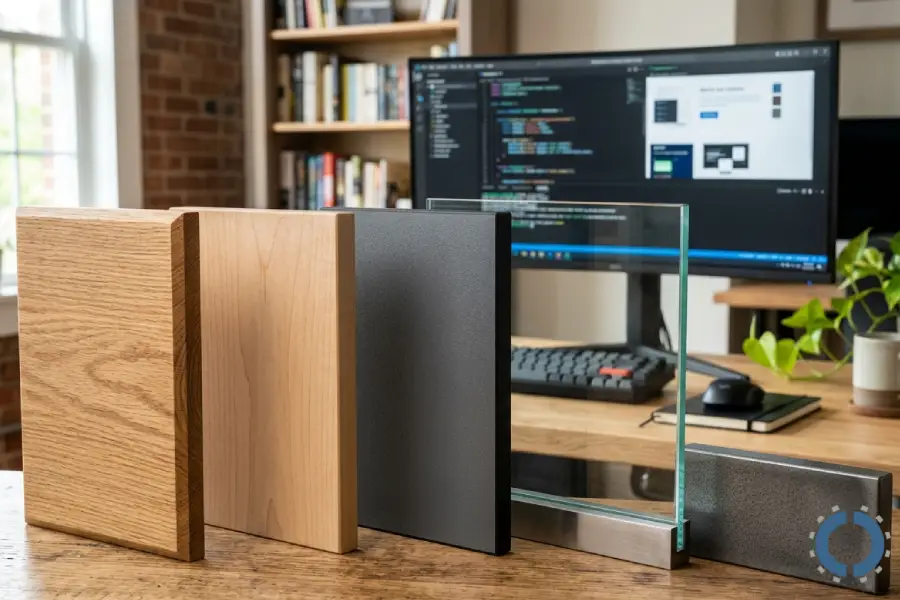
When we want to buy a computer table or office desk, its appearance is usually the first thing that catches our attention, but what really becomes important over time is its material.
So let’s answer this question: what are the top materials for computer tables?
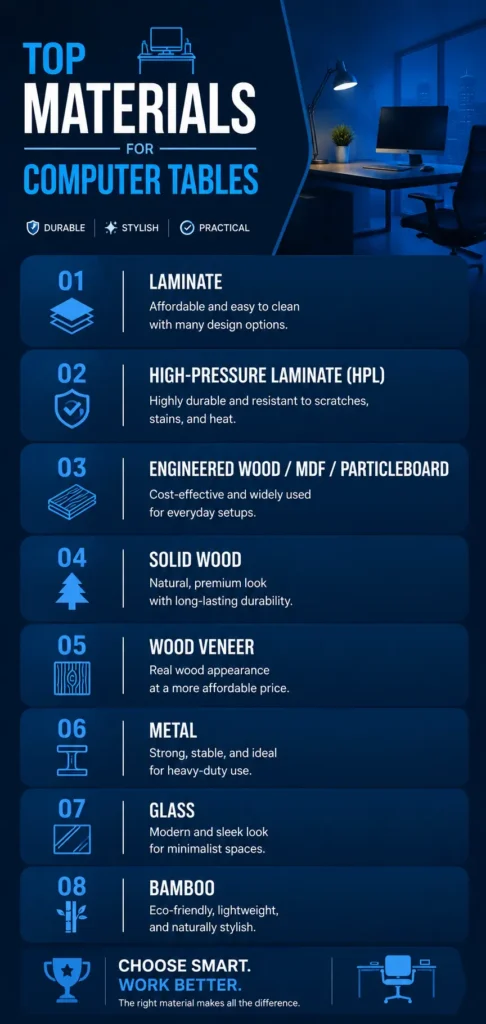
The top materials for computer tables are laminate, high-pressure laminate, engineered wood, solid wood, wood veneer, metal, glass, and bamboo. For most offices, laminate or HPL with a sturdy metal frame is often the most practical choice because it balances durability, cost, easy maintenance, and daily computer use. Solid wood and veneer work well for executive offices, while glass and bamboo are better for style-focused or lighter-use spaces. For Houston businesses, the right material should also fit your layout, budget, timeline, and installation needs.
The desk is a place where we spend hours working, studying, or even brainstorming.
For this reason, choosing the right material can affect our comfort, durability, beauty, and even our working health.
In this article, we are going to take a simple and practical look at the best materials used for computer tables and office desks; we will discuss the advantages and disadvantages of each so that you can more easily decide which option is best for your needs.
You Might Also Enjoy: Office Space Planning and Design: What’s the Difference
What Are the Top Materials for Computer Tables?
For most offices and work environments, the best choice is usually a laminate or HPL (High-Pressure Laminate) top with a sturdy metal frame.
This combination is considered one of the standard and very popular options in office tables and desks design due to its good balance between price, durability, and practicality.
From an economic perspective, these types of desks are quite cost-effective, especially when multiple workstations are to be equipped in an office.
Compared to solid wood, they are much less expensive and are a more logical choice for large projects.
The laminate surface is also easy to clean and is perfectly suitable for everyday use in busy office environments.
In terms of usability, this combination works well for laptop, monitor, keyboard, and cable management and is designed for continuous use.
Of course, it should be noted that this is not the “best option for everyone”; for example, wooden desks for luxurious spaces or ergonomic adjustable desks for health are better choices.
But if the goal is a practical, economical, and reliable choice for most offices, this combination is the best overall option.
Top 8 Materials for Computer Tables
 1. Laminate
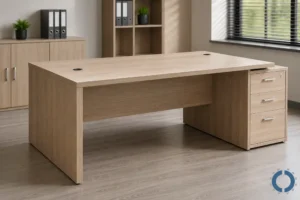
Laminate is one of the most common materials for computer tables and office desks.
It is also known as a durable desk surface for office use.
In most models, a layer of laminate is placed on top of materials such as MDF or particleboard.
This gives the table the look of wood or different colors, without the high cost of natural wood.
It is easy to clean and works well for spaces where several people use the table every day.
However, laminate quality varies.
On some cheaper tables, the edges may become damaged or chipped after a while.
For this reason, it is best to also check the quality of the edge banding and table frame.
Pros
- Reasonable price
- Easy to clean
- A wide variety of designs and colors
- Suitable for daily use as a computer table and in offices.
Cons
- Lower-quality models may get damaged around the edges.
- Its appearance does not quite resemble natural wood.
2. High-Pressure Laminate (HPL)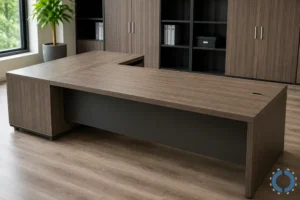
When it comes to the top material for computer tables, HPL, or High-Pressure Laminate, is usually one of the first choices.
This material can be considered a more durable version of regular laminate.
These two may look similar at first glance, but HPL is designed for heavier use.
This material is more resistant to scratches, stains, and heat.
For this reason, HPL computer desks or high-pressure laminate desks are used in many commercial spaces.
If you have a busy office or multiple people are going to use a workstation every day, HPL is usually a safer choice.
Especially for training rooms, computer labs, or shared desks.
Another advantage of HPL is that it has a professional appearance and is not difficult to maintain.
Pros
- Highly resistant to scratches and stains
- Suitable for heavy daily use and high-traffic offices
- Easy to maintain
- Professional appearance
Cons
- It is slightly more expensive than regular laminate.
- The quality of brands can vary.
You Might Also Enjoy: What Makes an Office Chair Ergonomic? A Buying Guide
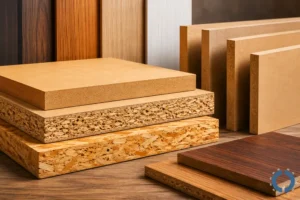 3. Engineered Wood / MDF / Particleboard
An engineered wood computer table is usually one of the first options.
This category includes MDF, plywood, and particleboard, and is found in many budget desks.
The biggest advantage of this material is its lower price compared to solid wood.
MDF usually has a smoother surface and is more suitable for indoor use.
Particleboard is cheaper and is used more in economy furniture.
But quality is very important in this category.
Some tables weaken after a short time, especially if the board is thick or the frame quality is poor.
If you are going to use a heavy monitor or if several people will use the desk throughout the day, it is better not to just focus on price.
Pros
- Economical
- High versatility
- Lighter weight than natural wood
- Suitable for simple setups
Cons
- Less durable than HPL or solid wood
- More sensitive to moisture
- The quality of models varies greatly
4. Solid Wood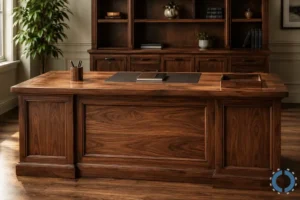
Solid wood gives computer tables a premium, natural look.
Its warm and natural appearance has made it popular in executive offices and private offices.
One of the good advantages of a wood office desk is that it usually has a long lifespan.
Even if a scratch occurs, in many cases it can be repaired or refinished.
But solid wood is not always the best choice for all offices.
These tables are usually heavier and more expensive, and are also more sensitive to moisture.
If you want to equip a large number of workstations with natural wood, the cost of the project will increase significantly.
Pros
- Luxurious and natural appearance
- High durability
- Repair and refinishing capabilities
- Premium feel
Cons
- High price
- Heavyweight
- Sensitivity to humidity
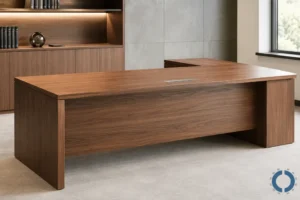 5. Wood Veneer
If you like the look of natural wood but don’t want to pay the price of solid wood, a wood veneer office desk can be a balanced option.
In these models, a thin layer of real wood is placed on the base material.
For this reason, veneer computer tables have a more formal and warmer appearance than laminate.
Many executive offices or client-facing spaces use veneer because it creates a more professional and stylish appearance.
Veneer is not as durable as solid wood.
If the build quality is poor or the desk is subjected to heavy use, it may start to peel or chip over time.
Pros
- Appearance close to natural wood
- Lower price than solid wood
- Suitable for formal spaces
Cons
- More sensitive to shock and moisture
- Possibility of damage over time
6. Metal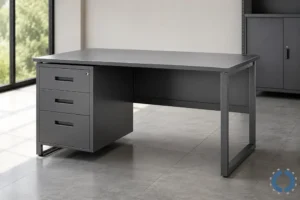
In most modern tables, metal is used mostly for the frame or base of the table, not the main surface of the table.
Metal frames, especially steel frame desks, are highly durable and suitable for heavy daily use.
Today, combining a metal frame with laminate or HPL is one of the most popular choices for offices.
This combination has both a modern look and offers good durability.
Cheap frames may wobble.
Pros
- High strength
- High durability
- Suitable for heavy equipment
- Modern appearance
Cons
- Some models have a very industrial look.
- Weaker models may vibrate.
 7. Glass
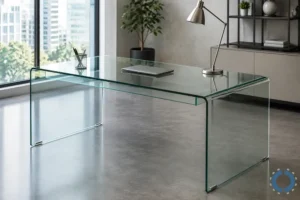
Glass computer tables are popular for their modern and minimalist look.
Glass is easy to clean, but it shows smudges, fingerprints, and scratches very quickly.
Therefore, it may require more cleaning in daily use.
Glass office desks are usually better suited for low-traffic spaces.
Pros
- Modern and stylish appearance
- Suitable for minimalist decor
- Easy to clean
Cons
- Quickly shows smudges and fingerprints
- More susceptible to scratches
- Not suitable for heavy use
You Might Also Enjoy: From Politics to Productivity: Top 7 Office Arguments After Elections
8. Bamboo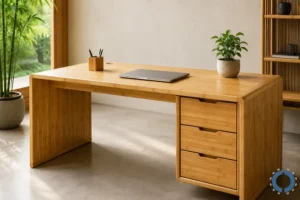
Bamboo is popular for sustainable office furniture in Houston.
This material is lightweight and has a warm, natural appearance.
Many also know it as an eco-friendly table material or a sustainable office desk.
Some people choose bamboo just because it’s eco-friendly, but the build quality is very important in these models.
In heavy commercial use, bamboo is not always as durable as HPL or metal frame desks, and some models require more maintenance.
Pros
- Eco-friendly and renewable
- Natural appearance
- Lightweight
- Suitable for modern design
Cons
- Some models require more maintenance.
- Its durability depends on the quality of construction.
Which Material Is Best for Different Office Uses?
When people search for what the top materials are for computer tables, they are usually not just looking for a list.
They want to know which material actually fits their office setup and daily use.
The answer really depends on how the desk will be used.
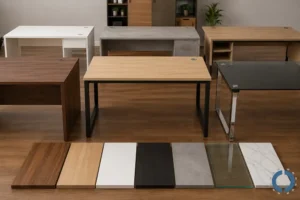
Best for Everyday Computer Workstations
For everyday use, the simplest and safest choice is laminate or HPL with a metal frame.
This combination is both durable and easy to maintain.
For those working with a laptop, monitor, and keyboard, this option makes perfect sense.
If you are looking for the best computer desk material for office use, this is usually the option that is recommended.
Best for Executive Offices
For administrative spaces, solid wood or wood veneer is usually a better choice.
Solid wood is more luxurious, but veneer can give the same feel for less money.
These options are usually a good choice for people looking for the best executive office desk material.
Best for Training Rooms
In training rooms, desks are moved around a lot and get heavy use, so HPL or laminate is the best choice.
They are easy to clean and easier to replace if they get damaged.
Best for Shared Workspaces
In environments where multiple people use the same desk, durability is the most important factor.
Combining laminate or HPL with a metal frame usually works best.
This combination is both strong and suitable for continuous use throughout the day.
Best for Modern Design-Focused Offices
If the appearance of your office is important to you, the options become a little more diverse.
Glass, veneer, metal composite, or bamboo are common choices.
They are an attractive choice for modern, design-focused spaces, especially when daily use is not overly intensive.
Best for Budget-Conscious Offices
If your budget is limited, you should look for more economical options.
Laminate, engineered wood, or even refurbished desks are logical choices.
You just need to make sure that the build quality meets at least a minimum standard.
You Might Also Enjoy: 16 Tips for Furnishing Your Office Space Without Wasting Time
How to Choose the Right Computer Table Material?
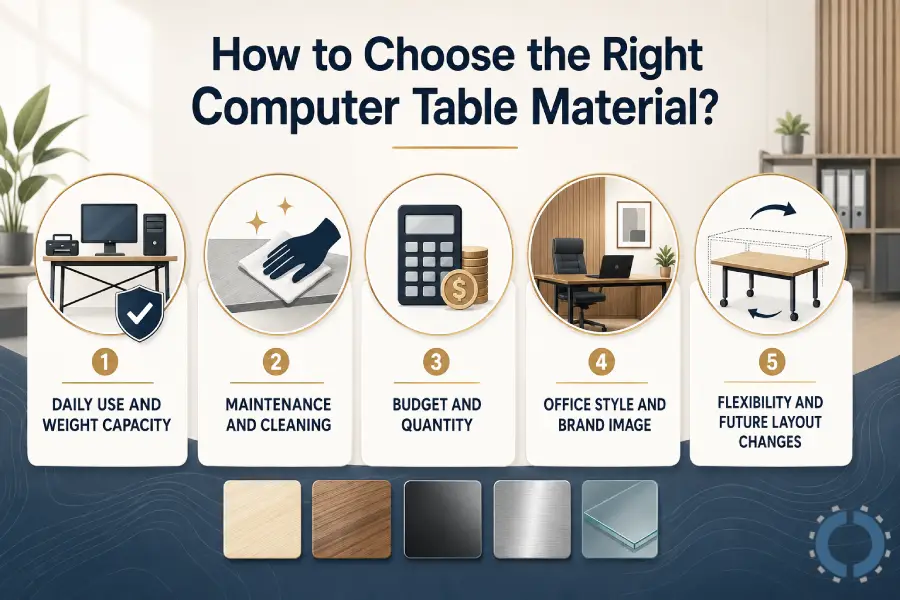
When choosing a computer desk material, you should think about how the desk will be used every day.
A few simple tips can make the decision much easier.
1. Daily Use and Weight Capacity
First of all, think about the type of daily use.
If your setup includes a monitor, a PC case, a printer, or even a dual-monitor configuration, then structural strength becomes important.
In this case, combining laminate or HPL with a metal frame is usually a safe choice.
2. Maintenance and Cleaning
In busy offices, desk cleaning is a major issue.
Surfaces like laminate and HPL are much easier to clean.
But materials like solid wood or glass require more care and are more likely to show stains or scratches.
3. Budget and Quantity
If you are going to equip multiple workstations or even an entire office, cost becomes very important.
In this case, choices like solid wood usually don’t make sense.
Laminate and HPL offer the best balance between price and quality here.
4. Office Style and Brand Image
The appearance of the office also plays an important role, especially in administrative or client-facing spaces.
If you want the space to look more formal and premium, wood veneer or solid wood is a better choice.
5. Flexibility and Future Layout Changes
Some companies, especially in dynamic cities like Houston, may change office layouts in the future.
In these situations, lighter, modular desks are a better option.
Materials such as laminate or its combination with a metal frame are easier to move and provide more flexibility in changing the layout.
Conclusion: So, What Material Should You Choose for Computer Tables
If you need a practical computer table for daily office use, choose laminate or HPL with a strong metal frame.
If you want a premium look for a private or executive office, choose wood veneer or solid wood.
If style matters more than heavy daily use, glass or bamboo can work well.
For most Houston businesses furnishing multiple workstations, laminate and HPL usually offer the best balance of durability, price, maintenance, and availability.
Need help choosing the right computer tables for your Houston office?
Collaborative Office Interiors can help you compare materials, layouts, workstation options, and budget-friendly office furniture solutions.
Contact us to explore available computer workstations, office desks, office chairs, office cubicles, and installation options for your workspace.

John Ofield is the owner of Collaborative Office Interiors. Houston’s trusted source for modern and commercial office furniture, office cubicles, demountable walls, office desks and tables, and complete workspace solutions. With more than 40 years of experience, he combines deep product knowledge with hands-on space-planning expertise to create ergonomic, productivity-focused work environments for businesses across Southeast Texas.