How Much Does It Cost to Furnish a Medical Office?

In today’s world, where healthcare services are taking on a new face every day, having a well-built and efficient office is no longer a luxury choice; it is considered one of the most important foundations for the success of any doctor.
Starting a new medical office may seem like just buying a few tables and chairs, but it is actually one of the most crucial steps in a doctor’s professional journey; a step that directly impacts the quality of work, the speed of service delivery, and even the patients’ sense of security.
Meanwhile, an important question always arises: exactly how much does it cost to furnish a medical office?
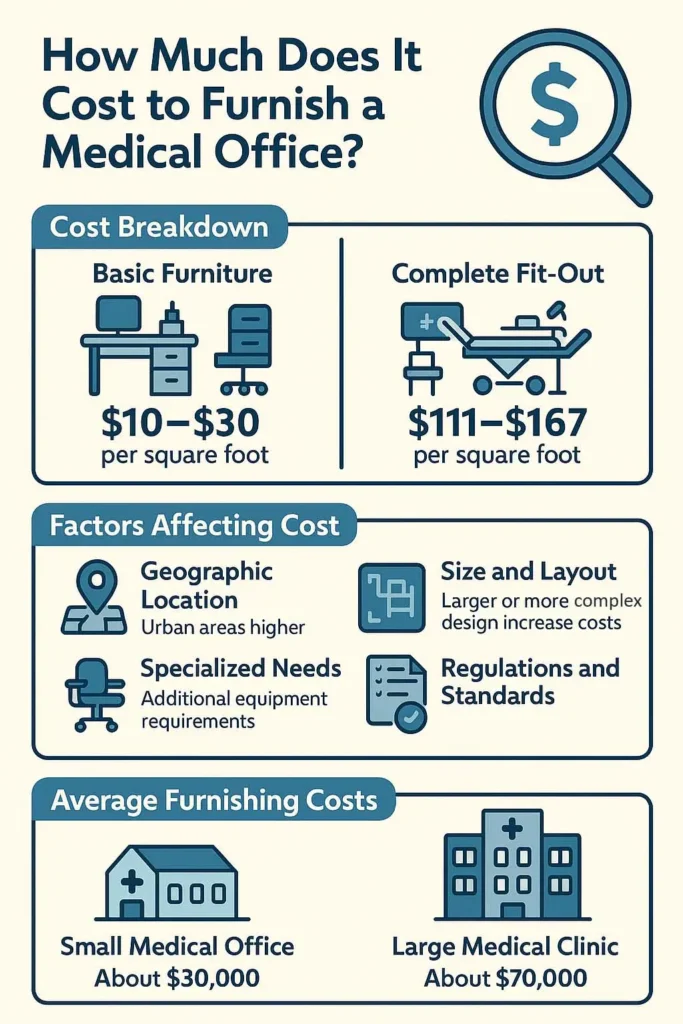
The cost of basic medical office furniture, such as tables, chairs, and storage space, is usually between $10 and $30 per square foot. But if you want a complete fit-out including coatings, non-medical equipment, and all the implementation details, this amount can reach $1,200 to $1,800 per square meter ($111 to $167 per square foot).
The final cost depends on the size of the medical office, the quality of the materials, the type of specialized equipment needed, and whether the items are purchased new or used.
With years of experience designing and furnishing medical offices in Houston, Texas, Collaborative Office Interiors is a trusted partner for realizing your ideal workspace.
We believe that building a professional medical office requires careful planning, budgeting, and purposeful design!
You Might Also Enjoy: Pros and Cons of Open Office Plans: 2026 Review
Factors Affecting the Cost of Furnishing a Medical Office
- Geographical location: The location of the office is one of the most important factors that affect costs.
The real estate market in cities like Houston can dramatically change the price of construction.
Typically, projects in urban areas are more expensive than those in suburban areas due to higher wages, administrative constraints, and infrastructure costs.
- Size and interior layout of the space: The size of the medical office directly affects the total cost.
The larger the space or the more complex the interior design—such as multiple examination rooms, a large waiting area, or specialized rooms—the more materials and labor will be required.
This ultimately leads to a significant increase in costs.
- Specialized needs of each medical office: Each medical field has its own requirements and equipment; therefore, the type of doctor’s specialty plays an important role in estimating costs.
For example, a dental office requires specialized equipment and infrastructure that is not similar to the facilities required by a skin and beauty clinic.
- Compliance with regulations and standards: Creating a therapeutic space requires compliance with a set of building codes, health standards, and obtaining official permits.
These regulations can affect the type of design, choice of materials, safety systems, and even the project implementation process.
Taking this path requires precision, experience, and sometimes additional costs.
- Current condition of the building: The initial conditions of the building chosen for the medical office play a large role in estimating the cost.
Furnishing a raw space usually involves walling, flooring, complete installations, and design from scratch; therefore, it will cost more.
In contrast, updating a relatively ready-made space is faster and more cost-effective.
Older buildings may also require major renovations to meet new standards.
From Vision to Budget: A Breakdown of How Much It Costs to Furnish a Medical Office
The average cost to build a medical office is typically between $450 and $1020 per square foot, but this figure is only an approximate index, and the actual cost of your project may vary greatly.
Several factors, from space size and type of equipment to interior design and professional standards, can change the final budget.
To better understand these differences and answer the question of how much it costs to furnish a medical office, it is essential to examine the various components of a step’s cost.
Construction Costs
1. Interior Finishing (walls, flooring, ceiling)
The type of materials you choose for your walls, floors, and ceilings has a huge impact on the final project budget.
The projected price ranges for 2026 are:
- Basic painted drywall: Approximately $2.50 to $5.50 per square foot.
- Vinyl composite or ceramic tile (VCT) flooring: About $3.50 to $9 per square foot.
- Special or soundproof walls: Usually between $11 and $22 and up per square foot.
- Epoxy flooring suitable for medical spaces: around $9 to $16.50 and up per square foot.
- Basic drop ceilings: Approximately $3.5 to $5.5 per square foot.
- Acoustic or custom-designed ceilings: About $5.50 to $11 and up per square foot.
You Might Also Enjoy: How Much Do Cubicles Cost? 2026 Guide
 2. Installation of Air Conditioning (HVAC) system
An efficient air conditioning system plays a key role in creating a comfortable environment for patients and maintaining sterile conditions in the medical office.
The final cost of this system directly depends on the size and type of equipment required.
For standard systems, the approximate price is estimated to be between $10 and $22 per square foot.
More advanced systems that allow for precise temperature and humidity control will naturally cost more.
3. Plumbing and Electrical Work
The complexity of designing and implementing plumbing systems varies depending on the specific needs of your medical office or clinic.
Adding specialized equipment, such as special sinks, radiology machines, or other advanced equipment, can significantly increase costs.
Approximately, the cost of this section ranges from $25 to $55 per square foot.
It is also a good idea to include additional costs related to installing advanced water and sewage systems or specialized imaging devices in your budget.
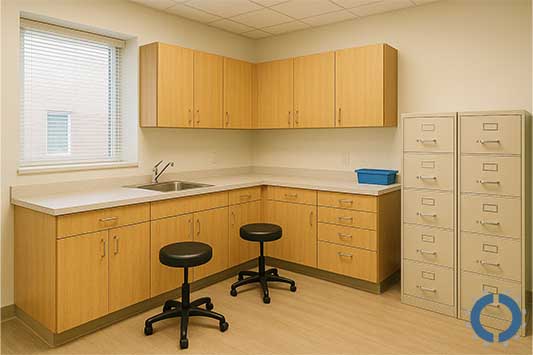
4. Cabinetry and Fixtures
One of the most important parts of the cost of furnishing a medical office is related to medical-grade cabinets, counters, and specialized laboratory equipment.
Whether you choose custom cabinetry versus prefabricated options, it will play a direct role in the final price.
Typically, standard medical filing cabinets and counters will cost between $150 and $400 per square foot.
5. Countertops
- Laminate: According to recent data, the cost of laminate materials ranges from $15 to $550 per square foot.
- Solid Surface / Corian: The price of this type of countertop – including materials and installation – ranges from $50 to $150 per square foot.
- Specialized lab fixtures: The cost of this type of equipment varies greatly and depends on the type of devices, the complexity of the operation, and the specific features of each tool.
Equipment and Furnishing Costs
1. Examination Rooms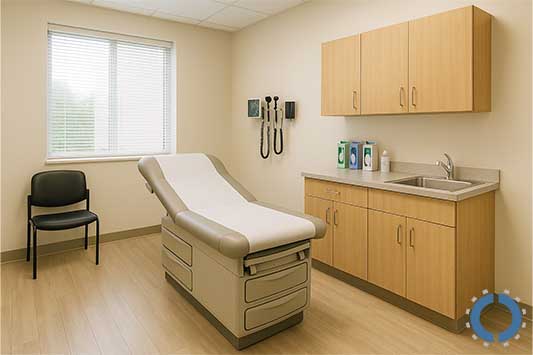
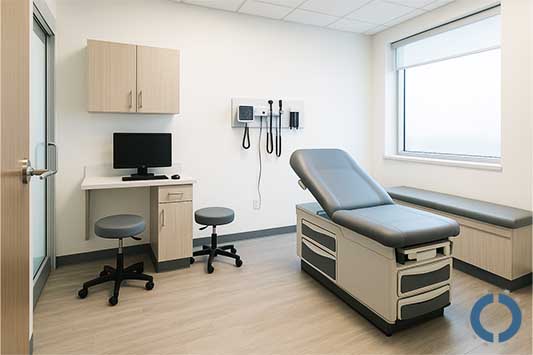
Setting up an examination room in a medical office or clinic requires a set of standard equipment, the cost of which will vary depending on brand, size, and quality.
A complete examination room usually includes the following:
- Exam Tables: The price of these tables varies between $1,900 and $3,500, depending on features and seller.
Features such as height adjustment, the presence of drawers, foam quality, and upholstery material (vinyl) affect the price.
- Privacy Curtains: Curtains used to separate spaces or create privacy around the bed.
Each curtain panel costs around $230 to $270.
The cost of rails and installation is also calculated based on the room design (such as L or U shape).
- Cabinets and Shelves: Wall and floor cabinets are used to store equipment, medications, and patient files.
Office cabinets range in price from $189 to $512.
- Doctor chairs and stools: Chairs that the doctor or nurse sits on to make the patient comfortable while examining them.
Simple models without backs are cheaper, but chairs with backs or antibacterial covers are more expensive, costing between $150 and $800.
- Patient chair: Used for the patient to sit during an examination or consultation, and usually costs between $150 and $600.
- Trash cans and accessories: Essential for collecting general or medical waste and maintaining room hygiene, and their price ranges from $30 to $250.
Total room cost: The total cost of equipping an examination room is usually between $2,600 and $5,400, depending on the brand and size of the equipment.
Some dealers, like our company, Collaboration Office Interiors, offer ready-made examination room packages that include all the necessary equipment and are ready to install.
You Might Also Enjoy: 12 Easy Exercises You Can Do At Your Office Cubicle
2. Reception and Waiting
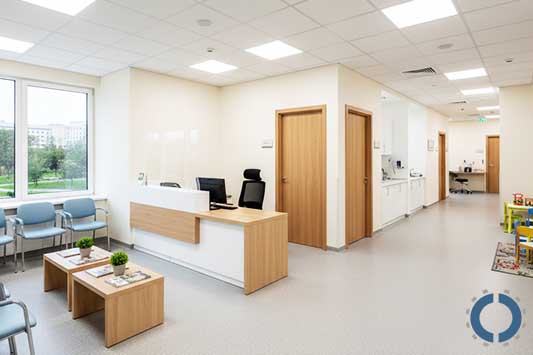
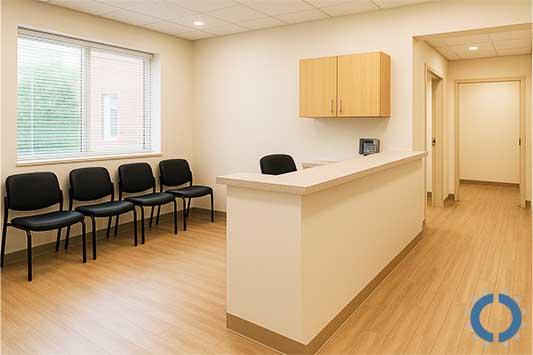
- Reception desk: The reception desk is the first point of contact patients have with the medical office or clinic, and should be both functional and attractive.
These desks usually have drawers, shelves, and ample space for computers and office equipment.
The approximate cost of reception desks is between $1,600 and $3,400.
- Waiting room chairs: The chairs used by patients while waiting should be comfortable, durable, and washable.
Their design must be resistant to constant use, and some models have handles, while others do not.
The approximate price per medical office chair is between $200 and $600.
Using comfortable, antibacterial, and highly durable chairs in the waiting room not only increases patient satisfaction but also enables better management of the waiting space.
 3. Nurse Station and Casework
The nursing station serves as the main personnel center for recording patient information, preparing equipment, and coordinating between departments.
These stations typically include an office desk, cabinets, shelves, and, in some cases, a sink and dedicated storage spaces.
The dimensions, height, material, and internal equipment of each station will vary according to the needs of the project.
To maintain hygiene and increase durability, the surfaces of the stations are often covered with antibacterial laminates or moisture- and impact-resistant coatings.
The cost of a medium-sized nursing station in 2026 is estimated to be between $1,500 and $4,000.
How Much Does It Cost to Furnish a Medical Office Based on Size
The size and scope of the medical office are the biggest determinants of the cost of its equipment and furniture.
1. Small Medical Offices
In small clinics that only have one or two examination rooms, costs will be much lower than in large centers.
Small spaces allow for more flexible design and a focus on the quality of equipment, not the quantity, by investing in durable medical furniture for a limited number of rooms.
Sample budget for a small medical office:
- Approximate Area: 1,400 square feet
- Number of Exam Rooms: 3
- Waiting Room Chairs: 10
- Number of Physicians: 2
Estimated Costs:
- Exam rooms: 3 x $3,500–4,800 → $10,500–14,400
- Reception and waiting area: $3,600–13,000
- Physician workspace (2 people): $1,800–5,000
- Nursing station and cabinets: $3,000–10,000
Approximate total furnishing costs: $19,000–42,000
Average: about $30,000
Features:
- Ability to focus on the quality of equipment rather than quantity
- Optimal investment in durable, high-quality medical furniture
2. Large Medical Clinic
Large clinics with multiple doctors require multiple examination rooms, waiting rooms, and workspaces, so costs will be higher.
Sample budget for a large medical office:
- Approximate area: 3,500 square feet
- Number of exam rooms: 8
- Waiting room chairs: 24
- Number of doctors: 5
Approximate costs:
- Exam rooms: 8 × 3,500–4,800 → $28,000–38,000
- Reception and waiting room: $6,000–18,000
- Physician workspace: $4,500–12,500
- Nursing station and cabinets: $10,000–30,000
Approximate total: $48,000–98,000
Average: about $70,000
Features:
- Large centers need to equip more rooms and cover work and waiting spaces.
- Specialized equipment and different types of furniture may be required for different medical disciplines.
- Purchasing equipment and furniture in bulk on a large scale, although the initial investment is higher, is more economical in the long run.
You Might Also Enjoy: How to Remove Cubicle Shelves: Your Complete Step-by-Step Guide
Why Every Medical Office Project Needs a Financial Cushion?
In medical office construction or equipment projects, even the best planning cannot eliminate all unforeseen events.
For this reason, allocating a portion of the budget as an emergency reserve is one of the measures that can make the project path much more reliable and controllable.
Based on COI’s long experience implementing healthcare projects in Houston, having a reserve budget can prevent many unexpected challenges and prevent the project from becoming a stressful and costly process.
Reasons why a backup budget is necessary include:
- Unforeseen infrastructure problems: During the work, you may encounter issues that were not apparent at first glance, such as rotten plumbing, damaged wiring, or old systems that need a complete overhaul.
Lack of additional funding can halt the work process and suddenly increase the overall cost of the project.
- Sudden changes in the prices of equipment and materials: The construction market is not always stable.
Price increases due to shortages, economic conditions, or changes in supply and demand are quite common.
If you have a reserve budget, these fluctuations won’t surprise you.
- New requirements or design changes: Sometimes, as the work progresses, new decisions are made, such as changing the layout of rooms, choosing different materials, or adding new equipment.
Without a flexible budget, these changes will quickly increase costs and financial strain.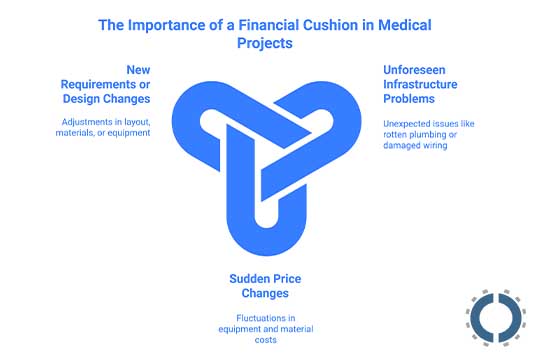
Now the question is, how much back-up funding is needed?
For simple, less challenging projects, around 5% of the total budget is suggested.
For more complex projects or renovations of older buildings: 10% or even more is reasonable.
How to Furnish Your Medical Office Without Breaking the Bank?
Equipping a medical office, while exciting, can become a costly endeavor without careful financial planning.
Collaborative Office Interiors’ long experience has shown that proper budget management brings the project to fruition faster and without additional costs.
- First, the essential costs, then the optional details: To start, you need to determine which parts need to be done immediately and which ones can be postponed until the future.
Equipping examination rooms, cabinets, and patient chairs is an essential element.
But choosing specific colors, luxurious materials, or additional embellishments can always be deferred to the office development phase.
- Negotiate professionally when renting space: If you are renting office space, be sure to negotiate the terms of the contract.
Many landlords are willing to cover some of the renovation costs, contribute to maintenance costs, or offer discounts if you ask.
- Access multiple offers: When purchasing equipment or selecting a contractor, always consult with several different groups.
Prices and quality of service vary greatly.
With careful comparison, you can find the best combination of quality and price and avoid paying unreasonable costs.
- Have a long-term view of costs: Sometimes buying cheaply at the beginning turns into heavy repair or replacement costs a few months later.
Choosing durable equipment and resistant materials is a long-term investment that will greatly reduce the cost burden in the future.
Conclusion
Ultimately, the answer to the question “How Much Does It Cost to Furnish a Medical Office?” is not just a number; it is an understanding of a set of factors that can each change the final cost.
The size of the space, the type of medical specialty, the necessary equipment, the quality of the furniture, the condition of the building, and even market fluctuations all play a role in shaping the budget.
What matters more is your approach to cost management.
With careful planning, setting priorities, exploring different options, and forecasting a supporting budget, it is possible to build a hospital that both maintains professional standards and is financially viable.
When furnishing a medical office, you need to understand that it is a long-term investment; every decision made today will affect your productivity, patient comfort, and professional identity for years to come.
So, if you are planning to equip your office or clinic and want to manage costs accurately, systematically, and according to your real needs, contact the expert team at Collaborative Office Interiors now.

John Ofield is the owner of Collaborative Office Interiors. Houston’s trusted source for modern and commercial office furniture, office cubicles, demountable walls, office desks and tables, and complete workspace solutions. With more than 40 years of experience, he combines deep product knowledge with hands-on space-planning expertise to create ergonomic, productivity-focused work environments for businesses across Southeast Texas.