How Open Plan Offices Affect Collaboration
Is your open plan office tanking your efforts to build a collaborative workspace?
The whole idea behind an open office plan is to bring people together, but often, the results are anything but.
But how do open-plan offices affect collaboration, really?
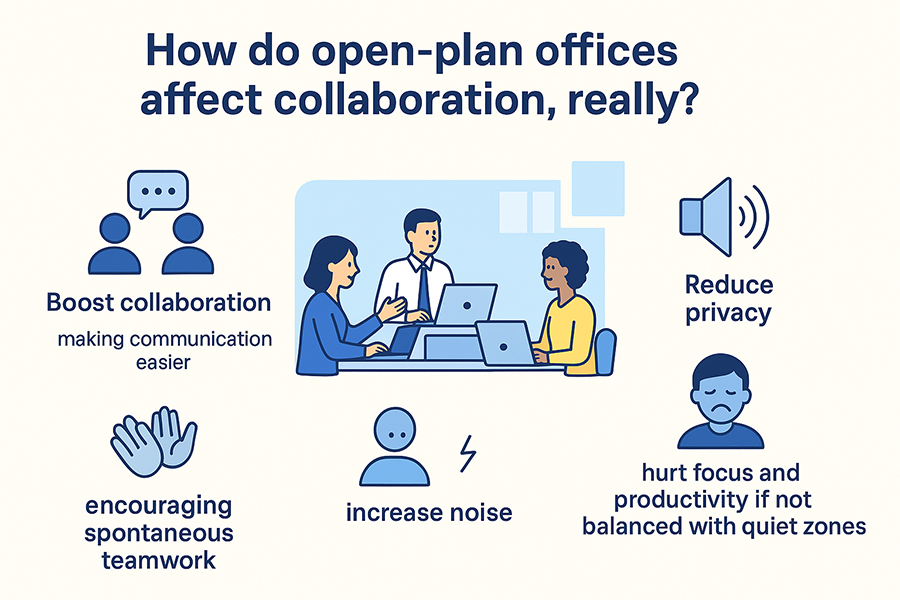
Open plan offices can boost collaboration by making communication easier and encouraging spontaneous teamwork, but they may also reduce privacy and increase noise, which can hurt focus and productivity if not balanced with quiet zones.
An open-plan office is a space where walls and separate rooms are removed to create an open, collaborative environment.
The main goal of this type of design is to create transparency, reduce costs, and enhance team interaction.
You need only look around an open office space to see what’s really going on.
People are working side-by-side, yes, but many of them take great pains to isolate themselves in their own worlds.
Either they have headphones on, or they are ensconced in the furthest regions of the office itself, hiding behind the lone ficus tree in the corner.
However, corporate experience and academic research have shown that the impact of open-plan offices on collaboration is not so simple and uniform.
The final result depends on factors such as careful furniture space planning, choosing the right office furniture Houston, organizational culture, and even management style.
In this article, we examine the advantages and disadvantages of open plan offices so that you can make the best decision based on your work style.
Background and Research Basis
One prominent study, titled “The impact of the ‘open’ workspace on human collaboration,” conducted by Ethan Bernstein and Stephen Turban (published in the Proceedings of the National Academy of Sciences), examined real-world data from two large companies and showed that after switching to open-plan offices, face-to-face interactions between employees decreased significantly, while digital communication (email and messengers) increased.
Bernstein himself admits:
“There’s a lot of interest in open offices because so many of us work in them, and we have very strong opinions about them.”
This finding was contrary to initial expectations from such a design.
Another article, “The Truth About Open Offices,” was published in the Harvard Business Review.
The article takes a deeper dive into how these spaces, while designed to foster collaboration and reduce organizational distance, can actually lead to reduced productivity, increased distraction, and even decreased job satisfaction.
Initially, many organizations believed that open-plan design would increase spontaneous interaction between colleagues, reduce unnecessary boundaries, and provide easy access to managers.
However, according to the data obtained through research and experience, it was found that employees are less inclined to have face-to-face conversations to maintain focus or avoid distractions.
Also, in open offices, digital interactions have replaced face-to-face communication. On the other hand, the lack of privacy can hinder creativity and real collaboration.
How Open Plan Offices Can Enhance Collaboration
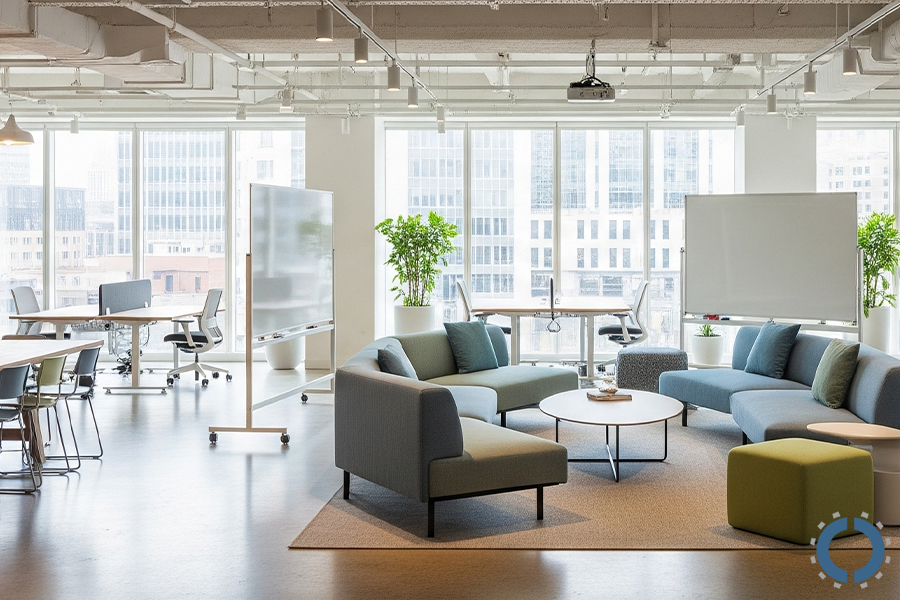
- Increased visibility and proximity to colleagues: In open plan offices, due to the lack of walls and physical barriers, employees see each other more often, which can lead to spontaneous conversations, rapid ideation, and instant exchange of ideas.
- Reducing organizational hierarchy: Eliminating separate rooms for managers and employees will reduce organizational distances.
This makes it easier to reach managers and creates a more transparent and friendly organizational culture.
- Creating flexible and collaborative spaces: Designing group areas or multi-purpose spaces in an open environment increases the possibility of interaction between different teams.
These types of spaces allow employees to more easily connect with members outside their team.
- Cost savings and reinvestment: The elimination of walls and integrated design reduces construction and maintenance costs.
Organizations can invest these savings in digital tools, training, or cultural activities, which themselves help foster collaboration.
The Drawbacks: How Open Plan Offices Hinder Collaboration
- Reduced face-to-face interactions: Research shows that in open-plan spaces, many employees avoid face-to-face conversations to avoid disturbing others.
The result is that digital communications such as email and chat are replacing face-to-face conversations.
- Noise, distractions, and constant interruptions: The lack of walls and boundaries means that the sounds of conversation, phone calls, or even surrounding movements can easily disrupt employees’ concentration.
This factor is one of the most common complaints in open-plan environments.
- lack of privacy: The apparent transparency of space may have a negative aspect.
Many employees in these environments feel constantly watched and have no personal space to focus or have confidential conversations.
- Decreased productivity: Despite the primary goal of increasing collaboration, open-plan offices can significantly reduce employee productivity.
Increased noise, frequent interruptions, and constant commuting make it difficult to focus on deep tasks, and even short interruptions of attention can reduce efficiency by 20–30%.
Also, the lack of privacy and the constant feeling of being watched create stress and psychological pressure and reduce motivation and work quality.

- Impact on mental health and job satisfaction: Constant noise, frequent interruptions, and lack of privacy can lead to decreased job satisfaction, increased stress, and even burnout.
Open-plan offices reduce the level of privacy for employees due to the lack of walls and physical boundaries.
This can make people feel like they have no real personal space to focus or relax.
Such conditions increase psychological stress and cause constant mental fatigue.
In addition, one study, in particular, conducted by the Scandinavian Journal of Work Environment and Health, concluded that open office plans can lead to lower job satisfaction and may actually reduce collaboration.
- One size does not fit all: Open-plan design is not practical for all people or tasks.
Introverts, those who need deep concentration, or teams working on sensitive projects, may be more negatively affected by this type of space than others.
Moderating Factors: What Makes the Difference
- Office layout details: The layout and design of the space play a vital role.
Using soundproofing, creating quiet zones or focus rooms alongside open spaces can provide the necessary balance.
- Culture and norms: Unwritten rules and clear expectations about when and where to talk, where to make phone calls, or use collaboration rooms have a direct impact on the quality of interactions.
Without the right culture, even the best design will be ineffective.
- Technology: Online collaboration tools, meeting scheduling systems, and features to support hybrid work or remote work can compensate for the weaknesses of open-plan offices and increase effective collaboration.
- Leadership and management practices: Training employees and managers about managing interruptions, policies for using private spaces, and encouraging respect for the privacy of others by organizational leaders plays a key role.
Active management can prevent chaos in open environments.
Shifting Gears: Making the Open Workspace More Collaborative
So, how do we address this? How do we meet employee needs for confidentiality and privacy within the open-concept design?
You don’t want your employees to lose the ability to interact. There’s a certain energy that teams need to maintain, and that can’t be done from behind multiple closed doors. However, you need to be realistic about their needs for separation, whether it’s for a few minutes, an hour, or for the day.
1. Choose the Right Collaborative Office Furniture
Creating dedicated zones in your open office space answers a range of needs. The collaborative office furniture you choose can be a big part of making it all work.
For example, you will need to include huddle spaces, small, separate areas for breakout groups that allow focus and concentration without having to leave the building. There are many styles of collaborative office furniture that support small groups or solo workers who need a little solace. Many can be equipped with data ports and power outlets as well, supporting their technology needs as they work together.
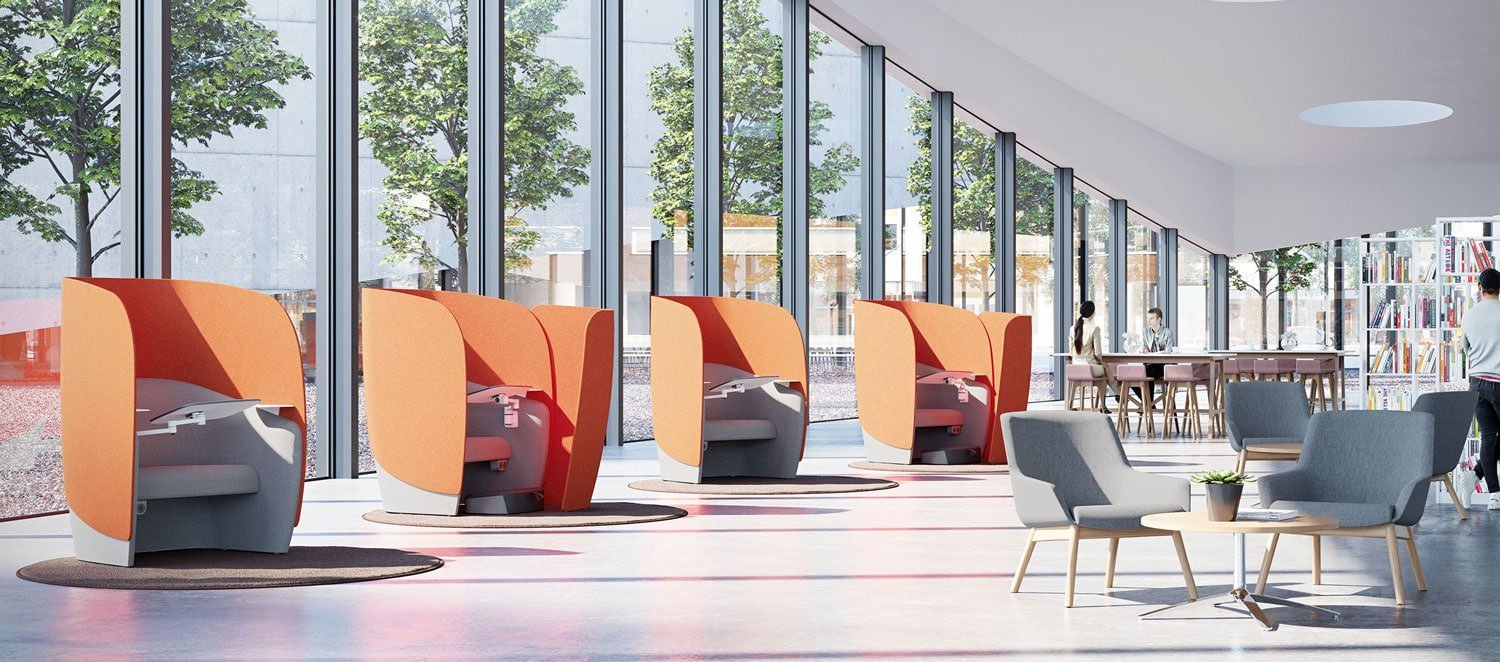
 To offer a little more privacy, specialty units like Cocoon are perfect. Each is an attractive, self-contained unit that seats two to three people and can be configured in groupings or as a stand-alone with tables to match.
Adding informal lounge seating is another terrific idea. This allows your teams to move between environments easily and settle in wherever they feel comfortable.
Above all, flexibility is critical. Create a collaborative open floor plan that can be changed easily according to your needs. This will help you establish a work dynamic that can ebb and flow as business requires.
If you would like to learn more about how to make your open office space more collaborative, reach out today to set up a consultation. Our office interior designers have lots of great ideas that will help your business soar.
2. Balanced Hybrid Layouts
A mix of open spaces and private spaces, such as office cubicles or breakout rooms, allows employees to choose the right environment based on their needs.
This balance allows for collaboration and deep focus at the same time.
3. Acoustic Treatment, Noise Masking, and Visual Barriers Where Needed
Using soundproofing, noise reduction systems, and visual barriers such as demountable walls and partitions in high-traffic areas reduces distractions and creates a more comfortable work environment.
4. Policies, Etiquette for Communication, and Interruptions
Defining clear policies about when and where to talk, make phone calls, and use collaboration spaces will minimize disruptions and foster a healthier organizational culture.
5. Flexibility in Working Methods
Features such as hot office desks, remote work, or hybrid work models give employees freedom of action and allow space to be used according to different needs.
How to Assess Whether an Open Plan Is Right for Specific Teams or Tasks
- Analyze the type of work: Does it require deep concentration, or is momentary interaction important?
- Identify team characteristics: Creative teams, research and development, or sensitive projects may require more private spaces.
- Collect employee feedback: User experience and perspectives are the best guides for refining internal design and policies.
Conclusion
In this article, we explained how open-plan offices can create a different experience for employees, with the promise of increased collaboration and transparency.
Despite the negative effects, this doesn’t mean that open offices are always a failure.
The tips we’ve outlined can help mitigate the negative effects and foster genuine collaboration.
Ultimately, there is no “one size fits all”; organizations must consider the type of work, team needs, and employee characteristics and design flexible, hybrid solutions for their workspace.

John Ofield is the owner of Collaborative Office Interiors. Houston’s trusted source for modern and commercial office furniture, office cubicles, demountable walls, office desks and tables, and complete workspace solutions. With more than 40 years of experience, he combines deep product knowledge with hands-on space-planning expertise to create ergonomic, productivity-focused work environments for businesses across Southeast Texas.